The Urgent Always Beats the Important — Unless You Build a System

You didn't set out to spend your days reacting. But that's how it goes when you're the one steering: the emails come first, the busywork comes second, and the things that would actually move you forward — the new goal, the skill you keep meaning to start, the project you've been putting off — get pushed to "next month" for the eleventh month in a row.
It isn't a discipline problem. People with a boss, a teacher, or a team have deadlines and check-ins doing the remembering for them. When you're working on your own — building a business, a craft, a skill, or a better version of your life — you have none of that. Every bit of structure you want, you have to build yourself.
The research on this is consistent: people who set specific goals and track them get more done than people who simply try their best. When there's no one else to pick up the slack, that gap is the difference between a year of real progress and a year that quietly slipped by.
Live by design and on purpose
We can live our life either by design, or by chance. As famous success philosopher Jim Rohn put it, "If you don't design your own life, chances are you'll fall into someone else’s plan. And guess what they planned for you? Not much." People living with no goals rarely have any purposes. Without purposes, what’s the point of living?
Gain focus and live life to the fullest
No matter how long you live, you only have limited time in this world. By setting goals and deciding what’s important and what isn’t, you can focus your life on truly valuable things. You will make the most out of your time and have the best chance at living a full life.
A key trait of all successful people
Strong goal setting and action-taking skills are some of the key secrets shared among all high achievers, such as Bill Gates, Steve Jobs, Oprah Winfrey, J.K. Rowling and many others. Not everyone will be successful by just setting a goal, but without goals, no one can achieve great success in anything.
If you don’t believe in setting goals, then you probably have done it in the wrong way. Here are a few common mistakes people tend to make in goal setting and how by avoiding these mistakes you will realize the true power of goal setting in making dramatic changes in your life.

Three Ways Goals Stall When No One Else Is Watching
- The goal is really a wish. "Grow the business." "Get healthier." "Learn to code." None of those tells you what to do on Tuesday. A goal you can't measure is one you can't make progress on, so it sits on a sticky note until you throw the sticky note away.
- There's a target but no plan. You know you want to launch something, finish something, or master something by spring. What are the fifteen things that have to happen first, in what order, and which one is this week's? Without that breakdown, the goal is too big to start, so you open your inbox instead.
- Nothing follows up. No one asks how it's going. Two quiet weeks turn into two quiet months. Most goals don't fail dramatically. They just stop getting looked at.

It's not easy to avoid making these mistakes, but that doesn't mean there is nothing we can do to increase our chances. Every mistake or failure has a hidden solution and once we recover and apply it, we will be able to achieve any goal we want.
Next you will learn seven scientifically researched and proven strategies that work the same whether you're building a business, a body of work, or a better life.
Seven Strategies That Work When You're On Your Own

1. Write it down, specifically
In a study done by Dr. Gail Matthews, a psychology professor at Dominican University in California, you are 42% more likely to achieve your goals just by writing them down. "Get more clients" becomes "sign four clients by March 31." "Get in shape" becomes "run a 5k by June 1." Now it's a target you can actually plan against.

2. Decide when and where the work happens
A study in the British Journal of Health Psychology found that 91% of people who planned their intention to exercise by writing down when and where they would exercise each week ended up following through, while only 35% achieved the same result relying on just motivation. "I'll do it when I have time" is the motivation version. "Tuesday and Thursday, 7 to 8 a.m., before the day gets away from me" is the version that actually happens.

3. Track the work, not just the outcome
According to a study published in Harvard Business Review, the most significant factor that influences our motivation to reach goals is a sense of seeing progress. Real results often lag behind effort — you can do everything right for six weeks and have nothing to show for it yet. Tracking your time and your action gives you visible progress during that lag, which is exactly when most people quit.

4. Put something in place that holds you accountable
In Dr. Gail Matthews’ study, the highest-achieving group didn't just write goals down — they reported progress to someone regularly. When you don't have a manager, a teacher, or a team, you need a stand-in: a weekly review you can't skip, a dashboard that shows red when something's gone stale, a study partner, a mastermind group, or a coach. The point is that someone — or something — notices.

5. Turn the recurring work into habits
Citing many scientific studies, the popular book The Power of Habits teaches us how habits form our behavior and achieve success both in life and business. Most of what moves any goal forward is boring and repeatable: practicing, publishing, following up, reviewing your progress. When you turn that recurring work into a habit, you put your progress on autopilot.
You are more likely to achieve worthwhile goals if you have good habits. Illustrating this, a 2007 study suggested that we're not motivated by goals alone. Once we've decided upon a goal, we're more motivated – on a day-by-day basis – by the habits that we have set up to reach it, than by the goal itself.
We're also motivated by reflecting on our progress towards our goals. A 2010 study reinforced this: here, researchers monitored people who were trying to form better eating habits. They found that those who were encouraged to reflect on how they were doing, and who adjusted their habits accordingly, were ultimately more successful.

6. Keep a record of what you tried
A study published in the journal Psychological Science showed that women who wrote about their values in a journal every night lost on average 3.4 pounds in four months while women who didn’t journal gained weight. Keeping a journal for your goals is where you write down which pitch worked, why the launch underperformed, what the last study session taught you, and what you'd do differently — a record that's worth more than most courses after a year or two.

7. Picture the outcome and the steps
According to research in brain patterns, visualization helps with your goal attainment. It works because neurons in your brains interpret imagery as equivalent to a real-life action, and then primes your body to act in a way consistent with what you want to achieve. This works best when you picture both the result and the process — the calls, the workouts, the pages written — not just the prize. By imagining the detailed mental picture of your desired outcome, and visualizing each of the action steps necessary to reach that outcome, your brain will help you make a positive and behavioral change that is needed to accomplish your goals.
Wouldn't it be great if there were a system that put all seven of these into practice for you automatically?
What Thousands of Goals Taught Us About Deadlines
GoalsOnTrack has been running since 2010. Looking at aggregate completion statistics across roughly 52,000 goals set in the app between 2017 and 2025, one pattern stood out more than any other:
Goals with a one-month deadline were completed 23.2% of the time. Goals with a one-year deadline were completed 5.3% of the time.
That's more than a four-to-one difference, and it applies no matter what you're working toward. A big annual goal — for your business, your body, your craft, or your bank account — is fine as a direction. It's a poor unit of work. The people who make progress are the ones who break the year into monthly goals with their own deadlines, work each one in a short sprint, and then set the next.
We call it the One-Month Rule, and GoalsOnTrack is built around it.
One Place to Run the Goals You're Responsible For
GoalsonTrack is a goal-setting and tracking app for people who are responsible for their own results — whatever the goal is. It takes the seven strategies above and puts them into a single workspace: your goals at the top, the plan underneath, this week's tasks in front of you, and the habits and hours that show whether you're actually doing the work.
It's not a project-management tool built for teams of forty, and it's not a habit app with a streak counter and nothing behind it. It's the layer in between — built for one person (or a few) making real progress on something that matters to them.

How GoalsOnTrack Puts the Seven Strategies to Work
Goal Dashboard: everything at a glance
Open the app and see your major goals, today's tasks and this week's habits on one screen. When a goal has gone quiet, its status color tells you before the month is out.

SMART goals: turn wishes into targets
GoalsOnTrack is designed to guide you to write down your goals in a SMART way so that you'll much more likely succeed in reaching them. "Get more clients" becomes "Add 3 new clients by Nov 30"; "get in shape" becomes "run a 5k by June 1" — with a purpose field so you remember why it mattered when the week gets hard.

Multi-level subgoals: chunk the big goal into work you can start
Break any big goal into the steps that have to happen first, by breaking down your long-term, complex, and overwhelming goals into small and manageable chunks — nested as deep as you need. Every big goal turns into a list of small ones with their own dates: the One-Month Rule, in practice.

Tasks and calendar: decide when it happens
Add tasks under each goal, set recurring ones for the work you repeat, and drag them onto the calendar. The iCalendar feed pushes them into Google Calendar, Outlook or Apple Calendar, so goal work sits next to everything else instead of behind it.

Time tracking: know where your hours go
Start a timer on any task, pause it, switch between them. See how much of your week actually went toward the goal versus everything else pulling at your attention. You will be able to easily track your time and the action completed for your goal.

Progress tracking: see movement before the results show up
Seeing immediate progress on whatever you do is the most powerful source of motivation. Track each goal by subgoals done, tasks completed, a numeric outcome, or manually — progress bars update the moment you check something off. This is the "small wins" strategy, built in.

Habit tracker: automate the repeatable work
Nothing can help you reach goals quicker than the right set of great habits. Set the habits your goal depends on, check them off on the habit calendar tool, and watch the software predict your habit strength. Miss a week and it shows.

Goal templates: don't start from a blank page
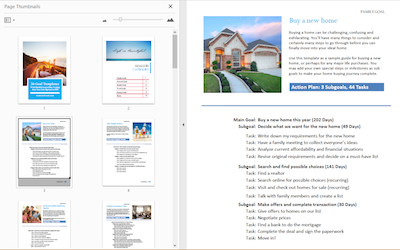
Not sure where to start on your next big goal? Adopt the built-in goal templates — for business, creative, learning, and personal goals alike — with a detailed action plan of sub-goals and tasks and even habits to help you jump-start your own goal. Or save your own goal as a template to reuse later.

Goal journal: keep the record
Use the goal journal tool to write down what you did for your goal, how you did it, and the lessons learned, right next to the goal. Bookmark the entries that matter. Not only will you have a written record of your progress, but you will also gain valuable insights along the way. Journal content is encrypted.

Vision board: picture the result and the route
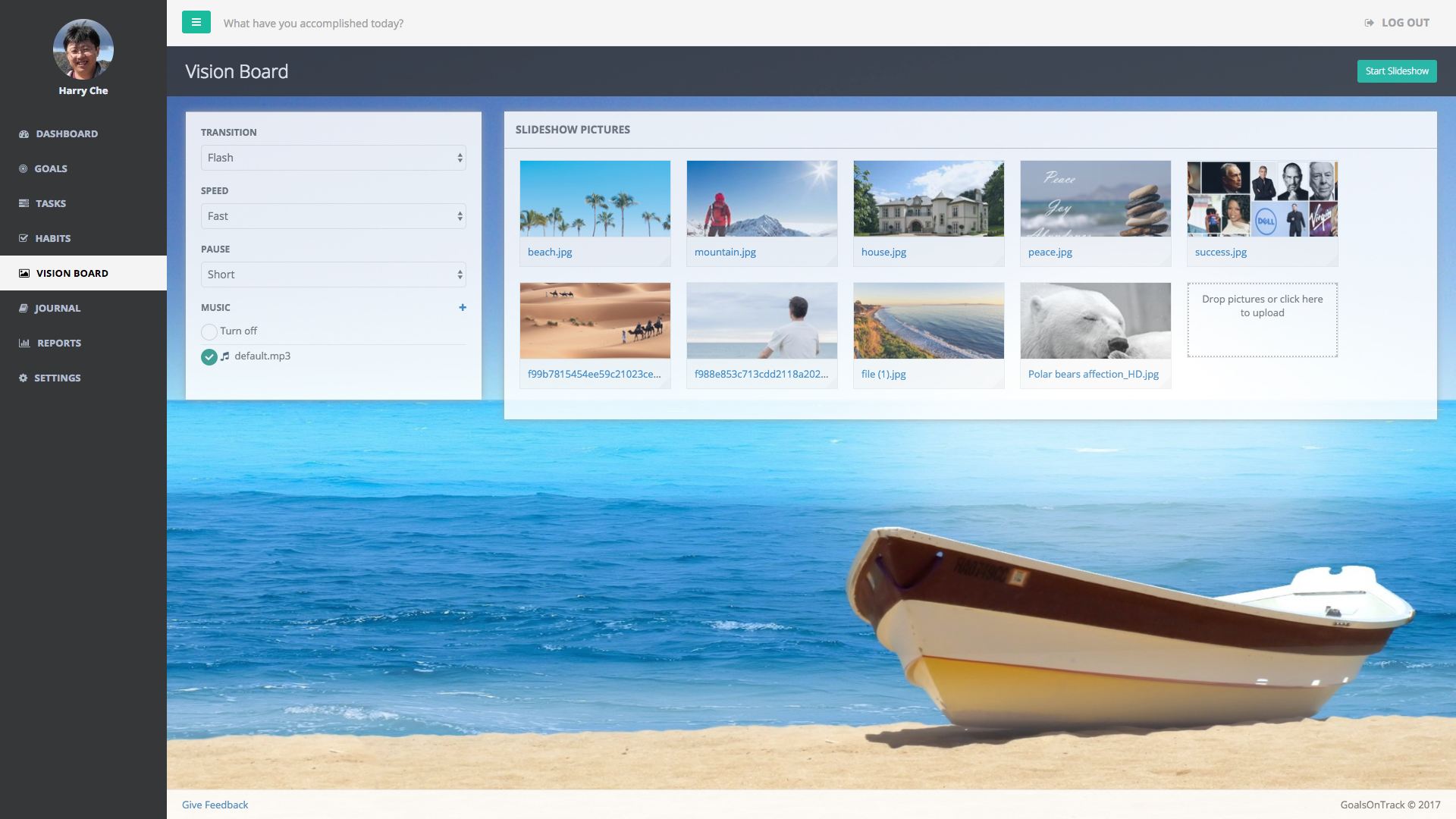
Visualization works because it taps into the huge power of the subconscious mind to make your goals happen. Build a board with your own images or the built-in library, set it to play as a slideshow, and use it for a two-minute reset before you get to work — visualizing both your goal's target outcome and the concrete steps you need to take to get there.
Reports and charts: your own progress review
Goals achieved, tasks completed, habits kept, and time logged — charted over any period, plus a Goal Review report. This is the check-in you'd get from a manager or teacher, built from your own numbers.

AI Toolbox: a second opinion on demand
Get suggestions for sharpening a goal into SMART form, drafting an action plan, or finding resources — tailored to the goal you're working on, even when there's no one else around to ask.

Working with a few other people?
In the Team version, everyone can share their goals with the group, and see what everyone else is working on and how much progress is being made — useful once you have a contractor, a study partner, a co-founder, or a few collaborators who need to see the same plan. For more details of Team version features, click here.

Built for People Who Answer to Themselves
Freelancers and consultants who want a pipeline goal, a skills goal and a rate goal to stop competing with client deadlines.
Solo founders and creators running a launch, a content schedule and a project at the same time, without a project manager.
Small business owners with a few staff who need their own priorities visible, separate from the day-to-day of running the shop.
Students and lifelong learners working toward a certification, a new language, or a skill, with no class schedule keeping them on track.
Anyone working on a personal goal — fitness, a book, a move, a habit — who wants the same structure a team would give them, without the team.
If progress depends on what you decide to do next Monday, this is for you.
Try It for 30 Days. If It Doesn't Earn Its Place, We Refund You.
Sign up, set up your first goal for this month, and work it. If after 30-day GoalsOnTrack hasn't changed how you plan your weeks, cancel from inside your account or by email and we'll refund the full amount within 48 hours. No forms, no questions, no exceptions.
We have never refused a single valid refund request, and will never do so in the future.

Sign up for GoalsOnTrack today...
Follow the 3 easy steps to get started.
1. Sign Up
Sign up to create your account. You will recieve a welcome email with login details.
2. Create a goal
Log in to create your first goal, or follow the sample goals to learn the basics.
3. Start tracking
Add sub goals or tasks to start tracking your goal progress, and more.
Your membership includes
- Unlimited access to the web and mobile apps
- Free upgrade on new features and future add-ons
- Free technical support on software usage
- Free access to all downloadable resources
- Bonus e-books on success and motivation
ONLY for $68 per year
Instant account activation.
30-day unconditional money-back guarantee. Cancel anytime.
Questions? Call us: 1-888-916-9906
Answers to Your Questions...
Q: Is this a to-do app or a project-management tool?
Neither. To-do apps track tasks with no goal above them. Project tools like Asana or Trello are built for teams coordinating work. GoalsOnTrack sits above your task list: it holds the goals you're responsible for, breaks them into plans, and tracks whether you're following through. Plenty of members use it alongside a work-specific project tool.
Q: I already use a planner or spreadsheet. Why switch?
Spreadsheets don't nudge you, don't track time, don't build habits, and don't show a red status when a goal has gone stale for three weeks. A planner works until the week it doesn't get opened. GoalsOnTrack keeps the plan, the schedule, the hours and the review in one place.
Q: How long does setup take?
Most people have their first goal, subgoals and tasks in place in about 15 minutes. The sample goals and templates cover common goals — business, creative, learning and personal — so you can start from one and edit.
Q: Can I use it for personal goals too?
Yes. Many members run business, creative, learning and personal goals side by side. The dashboard lets you choose which ones stay in front of you.
Q: Is my data private?
Journal entries are encrypted. All data is backed up daily. Payments are handled by our payment processor; we never see your card details.
Q: What if I have a question or need support?
Please send us your question using the message form at the bottom of each page on this web site. Or give us a call at the number listed next to the contact form. If you get a busy line, please do leave a message and your number or email so that we can get back to you.
If you have further questions, please check the full FAQ page .
What People Say About GoalsOnTrack
A big thank you.
Warmest regards.
Nobody Else Is Going to Set Your Goals for You. That's the Point.
Decide what this month is for, break it into work you can start, and let GoalsOnTrack keep score.
Sign up for GoalsOnTrack today...
Follow the 3 easy steps to get started.
1. Sign Up
Sign up to create your account. You will recieve a welcome email with login details.
2. Create a goal
Log in to create your first goal, or follow the sample goals to learn the basics.
3. Start tracking
Add sub goals or tasks to start tracking your goal progress, and more.
Your membership includes
- Unlimited access to the web and mobile apps
- Free upgrade on new features and future add-ons
- Free technical support on software usage
- Free access to all downloadable resources
- Bonus e-books on success and motivation
ONLY for $68 per year
Instant account activation.
30-day unconditional money-back guarantee. Cancel anytime.
Questions? Call us: 1-888-916-9906